
In my May round-up, I mentioned that I was in the process of finishing the last read of the five nominees for Best Novel at the Bram Stoker 2025 Awards. Well, I am here to say that I’ve since finished reading through King Sorrow, and am happy to report back that I have five strong recommendations for fans of quality horror literature.
This could get overly long if I wanted to do a big literary breakdown of each novel, or an in-depth critical review. Rather than that, since we’re all pressed for time, I’m just going to provide a quick recap and some insights. As such, you’ll be empowered to go out and make an informed decision when you pick up one (or all) of the books for your reading pleasure. (Before you do, though, I’d be eternally grateful if you subscribed to my website right here.)
Some quick notes: as an emerging writer myself, I don’t feel wholly comfortable writing deep critiques or glib hot-takes of works by talented writers. (Never mind that yours truly hopes to one day find their work on the same bookshelves – don’t shit where you eat, as the adage goes) At the same time, I don’t see any value in false praise or in blowing smoke up other author’s asses. As such, if something did or did not click for me, I’ll mention it while also noting what did work. The point is to celebrate the works, not to properly review them. There’s enough blogs out there that are more than happy to provide that type of review.
So. Here we go.
Witchcraft for Wayward Girls, by Grady Hendrix

Hendrix laid a foundation for his writing career on the backs of horror comedy novels like Horrorstor and My Best Friend’s Exorcism before pivoting to slightly more straightforward fare (albeit with tongue-in-cheek titles) like The Southern Book Club’s Guide to Killing Vampires and The Final Girl Support Group. What’s never been in doubt at any point in Hendrix’s literary career is his talent for creating passionate, human characters in deeply recognizable situations.
That holds true here with Witchcraft for Wayward Girls, which continues Hendrix’s perpetual leveling up (not that his previous works are lesser – disclosure, I love every one of his books). Further, Hendrix often writes strong female characters placed in conflict with strict, repressive society.
That continues here, as Fern is a teenage girl in the Deep South in 1970. When she becomes pregnant, she is shepherded away to the Wellwood Home, where she’s expected to have her child out of sight and mind before giving it up for adoption. She befriends other ‘wayward girls’ at the home, each of whom have their own circumstances that have led them there. Cases of abuse, neglect, shame – it’s not a great time or place to be a pregnant teenage girl, something Hendrix goes to great care to present with humanizing sympathy.
While there, Fern meets a librarian who gives her an occult book about witchcraft. From there, she and her friends slowly begin to find ways to acquire and exercise power that they’ve never had access to…and, as goes in these stories, complications ensue.
This is an excellent read, and I would highly recommend. If you enjoy this one, dive deeper into Hendrix’s bibliography. You’ll not regret it.
King Sorrow, by Joe Hill

I talked a bit about this one last week, so I’ll try and go light here. This one’s a dense boy, clocking in at well over 800 pages, but each of them are essential in this tragic revenge story. Quick recap – six friends decide to summon a dragon from another dimension to enact vengeance upon some nefarious characters threatening them. Naturally, things get out of hand once they learn that their bargain with the dragon has some loopholes they neglected to close.
Hill does a fantastic job of managing ensembles throughout most everything of his that I’ve written. Locke and Key has multiple main characters jumping in and out of the plot line, rising and falling in importance as necessitated by the story. King Sorrow is no different, allowing for each of the six friends to take center stage at varying points throughout.
Reading King Sorrow, I was actually most reminded of another ensemble dealing with a nightmare from another world – the Loser’s Gang from It. I’m not saying that Joe Hill is a nepo baby – he’s clearly a talented writer in his own right, with a hefty literary career that any writer would be proud of. But in reading this tome, it’s hard not to think that the apple in question certainly didn’t fall far from the tree. (Compliment, of course.)
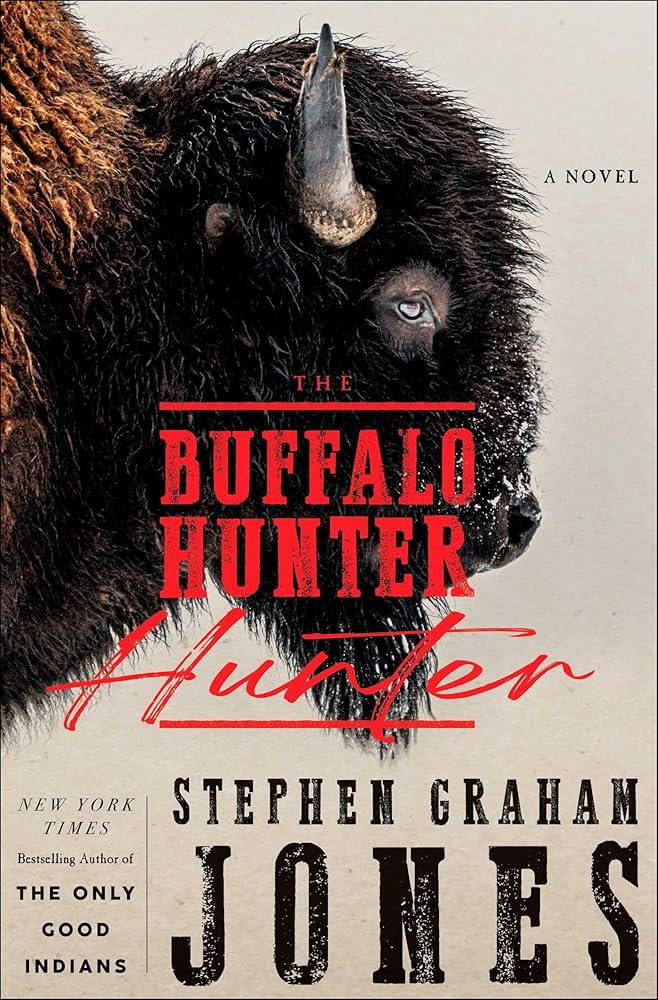
The Buffalo Hunter Hunter, by Stephen Graham Jones

I’m loathe to provide a plot summary for this one, lest it spoil the majesty and surprise of this one. Good lord, this one’s an excellent read.
When people talk about finding new ways to treat old myths, legends and stories, this is what they mean. Jones takes a very classic horror trope, inverts it, twists it inside out, and presents something wholly new and original. And it’s terrifying in its totality and singularity.
Stephen Graham Jones has been nominated for the Stoker Award for Best Novel six times. He’s won twice, winning for The Only Good Indians and My Heart is a Chainsaw. He may very well win a third for this one. One of the best horror writers of our time, of all time. If you only read one book from this list, start here.
The Bewitching, by Silvia Moreno-Garcia

As with Mexican Gothic, this story was beautifully hypnotic. There’s something about Moreno-Garcia’s prose that lulls you in. In recent years, I’ve come to greatly enjoy books that I have to, for lack of a better phrase, ‘learn how to read’. It’s not that a book can be exceptionally challenging or non-traditional, but rather the author is working in a different style than expected or that I’m used to. As such, there’s at first confusion and feet-dragging followed by a moment of enlightenment where everything ‘clicks’. From that point on, there’s little beyond the basic need of sleep that will get me to put the book down.
This was a case where I very much had to learn how to read The Bewitching. Once I did, though, I could not put it down. Another story of witches, this one drawn across two generations of a Mexican family plagued by supernatural forces. Minerva is a graduate student studying the life of Beatrice Tremblay, an obscure horror author. As she does, she uncovers a fantastic story behind Tremblay’s novel that reflects stories from her Nana Alba’s childhood.
At times, The Bewitching can be chilling, at times horrifying, and at all times it’s a story bound by elegant prose, lyrical and dazzling. Witchcraft is having a moment in popular culture these days, and that includes horror fiction as evidenced by two of the nominated novels featuring these supernatural elements.
Girl in the Creek, by Wendy N. Wagner

If I’m honest, this is the one nominee that I connected with the least. At the same time, the overall concept and the big “baddie” here have lingered in my head longer than any of the other novels, so make of that what you will. What I will say is that this is a compelling read with a thoroughly unique concept that never goes where you’re expecting it to.
Set in the majestic, verdantly green, thoroughly drippy and damp Pacific Northwest, the novel tells a story of missing persons and alien species. Journalist Erin Harper arrives in the town of Faraday, searching for her missing brother, along with a group of friends. As it goes in these types of stories, what they find winds up beyond anything they could possibly have comprehended.
At the risk of spoiling plot points, this novel uses fungi and mycelium structures in a fascinatingly unique way. That’s the part that’s stuck with me so much – the notion of a vast, rotting, living organism with a hive mind and its own agenda outside of human norms. As might be expected, this book goes to some squeamish places, utilizing body horror throughout. But it’s never overtly gory – it’s body horror as viewed through a sentient mushroom, which is its own kind of horrifying.
So, yes, this is absolutely a worthwhile read, and may be the most unsettling of the five tomes collected here. Plus recommendation.
There you have it. Five books, five different stories, five different scares, all of them 100% worth your time and energy. Happy reading, y’all.
*Personal plea – if you’re going to purchase these, please do so from your local independent bookstore. I understand the Amazonian temptation, but fight this urge if at all possible.
Leave a Reply